
Why Hunters Should Anthropomorphize Their Quarry
Because we don't need more people who feel nothing

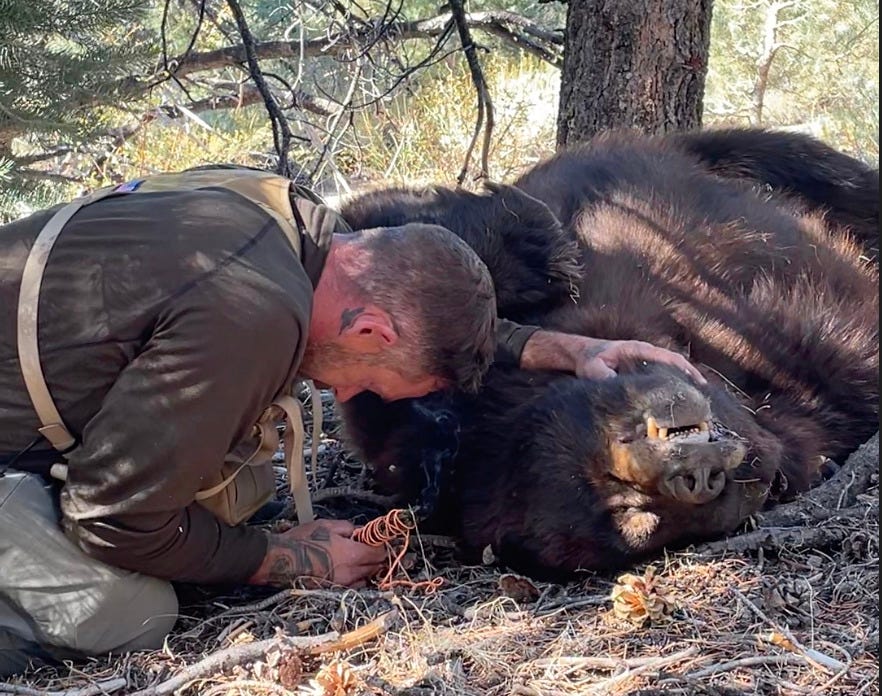
To kill without empathy is to be numb.
Currently, there is a rather specious, and I would argue culturally fabricated, and politically motivated debate about the problem of anthropomorphization in conservation. Some hunting organizations like HOWL have argued that anthropormophization of animals. “in wildlife management undermines effective conservation practices and misrepresents the realities of nature,” as they wrote in one blog post. Yet in the same post, the author argues correctly “that humans themselves are inherently wild.” What HOWL fails to recognize is that you cannot logically hold these two truths separately.
If we are wild, we must also understand animals as sentient. And sentience requires anthropomorphization. The truth is that hunters should anthrophomorphize their kill.
First off, what HOWL and political organizations like them get wrong is that most wildlife conservation does not anthropomorphize animals for fear for being attacked of sentimentality and an uncritical discussion of animals. But both hunters and wildlife conservation should anthropomorphize because they truth is, if we are wild (and we are), then we must recognize that we are a part of the landscape and the wilderness. Doing this necessitates rebuilding our relationship with landscapes and the wildlife that live there.
Hunting is Relational
Listen, I am a hunter and a hunting guide, so I know I am going to get a lot of flak for this. But there are a lot of problems with the hunting community. Most often hunters pursue game as some sort of conquest. I mean all you have to do is look at the over-the-top music choices from most any IG hunting post to understand hunting is not about relationship for some folks, it is about domination and is performative. For some, hunting is about sticking your dick in the woods and fucking it, as I always say. But it shouldn’t be.
Hunting, like most things in life, should be relational. We should see the animal we are hunting not as a target but as a relative, a mirror, a teacher, as kin. The moment we reproduce these fake macho narratives about killing an animal, we not only reveal our own fear and inadequacies as tracker and author Paul Rezendes says, but we separate ourselves from the wild and the very nature we claim to be a part of. Wildness and being wild means we dig into the dirtiness of that relationship with the thing are hunting. It means grappling with the reality that we are killing a sentient being, not some dumb animal munching on berries.
This is hard. I know. It requires really diving into our relationship with death, with life, and with our ego. What I am saying is also hardly revolutionary. All indigenous communities did this. They spoke, and still speak, to their prey. They ask permission. They give thanks. And they don’t do it because bear can speak English, but because relationship requires acknowledgement. And yes, I know there are plenty of (if not most) hunters today who do this still, but there are a loud few who do not.
There is a real weight to taking a life. Aldo Leopold describes killing a wolf in a rim canyon in New Mexico in his book A Sand County Almanac, and he puts it like this. "We reached the old wolf in time to watch a fierce green fire dying in her eyes." Pretending an animal is some mindless machine allows for a clean conscious. But when you imagine the animal has its own subjectivity, you’re forced to confront what it means to end that experience. This is not about guilt—it’s about grief. And grief is holy and necessary in hunting. And when a hunter reckons with that grief, it means they are in right relationship with the land, the animal, the mystery of life and death, and possibly even themselves.
Anthropomorphization Deepens the Relationship
Modern culture has domesticated us into separation – from animals, from death, from our own feelings. Anthropomorophism breaks downs this specious human/nature binary and restores a sense of belonging in the food chain. When we anthropomorphize consciously, we re-emerge in an ecosystem as a feeling, accountable, human-animal. When we practice anthropomorphization consciously we can begin to not only have better relationships with the wild, but with ourselves, and begin to practice hunting in a relational way.
Anthropomorphization also counters modern hunting narratives that rooted in domination. Hunting shouldn’t be about conquering or proving some sort of colonialist mentality onto the outdoors. Hunting (and all outdoor pursuits) are about building a relationship with nature. It doesn’t make you more of a man because you killed a deer or bear. It doesn’t make you stronger or more powerful because you took a life.
No, in fact anthropomorphization allows us to soften our hearts without dulling our blades. It says I can still take a life, and I can weep as I do so. And in that tension is where transformation happens. That is where we connect not just with the animal and the natural world, but with our souls. To imagine the soul of the animal is not to impose human feelings—it is to awaken our own.
Rewilding is the Integration
The way some hunting organizations talk about rewilding, they must think it is some fantastical return to a time that never was. That is just not true. Rewilding is not about feral regression but reconnection, which means including humans as part of the landscape and ecosystem. That’s the very definition of it. Let’s face it, hunting needs a rewilding reckoning. The more we imagine animals as sentient, the more we remember we too are animals and a part of ecosystems. Rewilding is not about some animal rights activist trying to take away your right to hunt or tear down “science-based” approaches (which have their own political problems, but that is a different essay.). No, rewilding restores the relational field connecting hunters to their body, land, and sacredness of the hunt.
Rewilding reconnects the hunter to the full spectrum of ecosystem relationship – body, instinct, emotion, death, grief, and reverence. We must imagine what the bear or elk is doing. And when we do that, we reflect inwardly. Where do I flee when afraid? What do I need to feel comfortable? These questions become not some sort of spiritual mumbo jumbo but an integral component in the hunter’s toolbox because it helps us get in the mind of the animal and better predict behavior. That is right anthropomorphization and rewilding might just make you a more attuned and better hunter.
Hunting is perhaps the greatest pursuit that can immerse us in an ecosystem. When we hunt, we become active participants in that ecosystem. When we hunt predators, that linear food chain diagram becomes to get a bit murky. Being immersed in an ecosystem requires anthroporphism and rewilding.
Hunting can, and should, be a sacred act. But this requires full presence. And presence requires empathy. Imagination. A willingness to weep if you must.
This doesn’t make you soft. It makes you real.
So name the bear, if you must. Speak to the elk before you shoot. Let yourself wonder what the world looks like through his eyes. You don’t diminish the hunt by doing this—you deepen it.
The wild does not need more people who feel nothing.
It needs more people who remember what it means to be alive.
If this piece stirred something in you—whether anger or grief or recognition—share it. Pass it on to your hunting buddies, your conservation group, your skeptic uncle. And if you want more writing on wildness, masculinity, grief, and re-enchantment, consider subscribing.
You can also find me over at The Wild Lab Podcast where we talk about this stuff in real time.
Stay wild,
Ned
Hi Ned. Nice piece. I think the scientific community has a real problem with this anthropomorphization concept. I was watching a video yesterday about apparently altruistic behavior in humpback whales which will interfere with sharks who are hunting seals and other animals, even risking themselves to do so. Now there are other possible explanations for this—discouraging predation within their own territory, for instance—and these are being considered as they should. But one has only to watch YouTube videos of acts of interspecies protective behavior to get a strong sense that some sort of altruism comes readily to some other mammals. And I’m not talking about the AI videos. 😉 scientists like to say we can’t know what other species are feeling or thinking so we should not assume they are thinking and feeling like us just because their actions seem to match our thoughts and feelings. Really? Is the dog the hides under the bed during a thunderstorm not accurately described as “afraid” of the thunder? We cannot actually prove that even other human beings are thinking and feeling like us since our only means of determining this is language, which is both a crude instrument of neurological description as well as subject to prevarication. To assume animals are completely different from us even when their behavior strongly indicates otherwise is itself unscientific—it replaces the dangers of anthropomorphic perspectives with completely androcentric perspectives—only humans could possibly feel altruism or other higher emotions. Well, says who? It’s an act of alienation from the natural world that is not in fact empirically justified but only possible due to an a priori assumption about the vast gulf between humans and the rest of creation.